
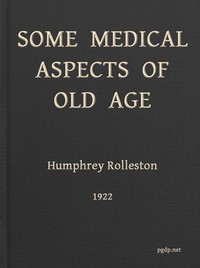
Some Medical Aspects of Old Age by Sir Humphry Davy Rolleston
Let's be clear from the start: this is not a novel. There's no plot in the traditional sense. Published in 1922, 'Some Medical Aspects of Old Age' is a snapshot of medical thought from a century ago. Sir Humphry Davy Rolleston, a leading physician of his era, acts as our guide. He doesn't tell a single story, but rather surveys the landscape of early 20th-century geriatrics.
The Story
Think of Rolleston as a medical reporter summarizing the big questions of his day. The 'story' is his investigation. He walks us through what doctors then considered the main issues for older adults: heart and kidney function, digestion, and that ever-present worry, 'hardening of the arteries.' He discusses theories on longevity, the impact of lifestyle, and the very definition of 'old age.' It's a systematic, chapter-by-chapter look at the body's systems and how they were believed to change with time. The narrative drive comes from following his logical, curious mind as he pieces together the standard medical knowledge of 1922, noting where consensus lies and where confusion remains.
Why You Should Read It
This book is a time capsule, and that's its magic. Reading it, you're struck by two things. First, how much we've learned. The causes and treatments he discusses are often completely different from today's. Second, and more surprisingly, how much the core concerns remain the same: maintaining independence, managing chronic conditions, and preserving quality of life. Rolleston writes with a calm, reasoned authority, but also with a clear compassion for his subject. You get the sense of a profession on the cusp of change, moving from simply observing decline to actively seeking ways to delay it. It’s humbling and fascinating to see the foundations of modern elder care being laid, brick by careful brick.
Final Verdict
This book is a niche gem, but a brilliant one. It's perfect for history buffs, medical professionals curious about their field's past, or anyone interested in social history. It's not a casual beach read, but for the right person, it's absolutely captivating. If you enjoy podcasts like '99% Invisible' or 'The History of Medicine' and like the idea of primary source material, you'll appreciate this direct line to a doctor's mind from 100 years ago. Just don't go looking for health advice you can use today!
No rights are reserved for this publication. Knowledge should be free and accessible.






Melissa Gonzalez
6 months agoFast paced, good book.