
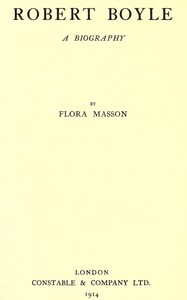
Robert Boyle : A biography by Flora Masson
Let's set the scene: London, 1914. Flora Masson, a writer and editor, picks up her pen to tell the story of a man who died over two centuries earlier: Robert Boyle, one of the founding fathers of modern chemistry and a key member of the early Royal Society. This isn't a modern, slick biography. It's a journey back to the 1600s, guided by a sharp early-20th-century mind.
The Story
Masson walks us through Boyle's privileged but studious life. We see the young man, inspired by Galileo's troubles, deciding to dedicate himself to experimental philosophy—what we'd call science. The book follows his move to Oxford, his famous experiments with air pumps (leading to Boyle's Law), and his role in forming the Royal Society. But Masson paints a full picture. This isn't just about science. Boyle was a deeply religious man who saw his work as uncovering the mechanics of God's creation. He was also a director of the East India Company, a writer on theology, and a shy, sickly person who avoided public life. Masson shows us the whole man: the wealthy aristocrat funding his own lab, the pious Christian, and the pioneering thinker.
Why You Should Read It
What makes this book special is the voice telling it. Reading Masson, you get two histories for the price of one. You learn about the birth of the scientific method, which is fascinating in itself—imagine being the first person to prove air has weight! But you're also seeing how a smart, capable woman a century ago interpreted that history. Her respect for Boyle's intellect and his fusion of faith and reason is clear. She's careful, thorough, and clearly wants her reader to understand why this quiet man changed the world. It feels less like a lecture and more like a thoughtful conversation with a very well-read friend.
Final Verdict
This book is perfect for history buffs who enjoy primary sources and a unique perspective. It's for readers curious about the Royal Society's early days, or those interested in the often-overlooked contributions of women writers to history and science writing. If you prefer fast-paced, dramatic narratives, this might feel slow. But if you like to settle into a detailed, thoughtful portrait of a pivotal era—and the writer who brought it to life—you'll find Flora Masson's biography of Robert Boyle surprisingly rewarding. It's a quiet conversation across time that still has something to say.
The copyright for this book has expired, making it public property. It serves as a testament to our shared literary heritage.
Margaret Walker
8 months agoClear and concise.
Anthony Young
1 year agoVery interesting perspective.




Jackson King
3 months agoVery interesting perspective.