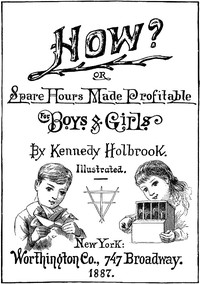
How? or, Spare Hours Made Profitable for Boys and Girls by Kennedy Holbrook
Forget about a traditional novel. 'How?' is a practical guide, a how-to manual for young people from 1910. It assumes you have 'spare hours' and that the best way to fill them is with productive, money-making, or skill-building projects. The book jumps from topic to topic with cheerful efficiency.
The Story
There isn't a narrative story. Instead, think of it as a series of short chapters, each answering a 'how' question. How do you make a simple telegraph? How can you build a weather vane? What's the best way to start a small garden or care for pet rabbits? The author, Kennedy Holbrook, provides clear instructions, diagrams, and lists of needed materials. The 'conflict' is simply the challenge of the project itself—transforming idle time into something tangible, whether it's a handmade toy sailboat or a few pennies from selling homegrown vegetables.
Why You Should Read It
I loved this book for its window into another time. The values are so clear: self-reliance, craftsmanship, and a direct connection between effort and reward. It’s charmingly earnest. There’s no mention of video games or social media, obviously. The entertainment it suggests is building a crystal radio or learning magic tricks. It made me appreciate simple, hands-on creativity. Some advice is timeless (basic woodworking), while other bits are hilariously dated (certain money-making schemes). Reading it feels like listening to a well-meaning, slightly stern grandparent from a century ago. It’s not preachy, but it definitely has a point of view: your time is valuable, so use it well.
Final Verdict
This is a perfect little find for history lovers, fans of vintage how-to books, or anyone curious about early 20th-century childhood. It’s not a page-turner in the usual sense, but it’s a compelling snapshot. Parents might enjoy comparing notes with the past, and DIY-inclined kids might still find a project or two to try. Just be ready for a different mindset—one where 'profit' for a kid could mean a new skill, a finished project, or literally two cents for a hand-painted postcard.
This work has been identified as being free of known copyright restrictions. It serves as a testament to our shared literary heritage.
Mary Clark
1 month agoI have to admit, the narrative structure is incredibly compelling. I would gladly recommend this title.
Michael Nguyen
8 months agoLoved it.
Amanda King
6 months agoThe layout is very easy on the eyes.
Mark Miller
1 year agoGreat digital experience compared to other versions.

Steven Torres
1 year agoI had low expectations initially, however it provides a comprehensive overview perfect for everyone. I learned so much from this.